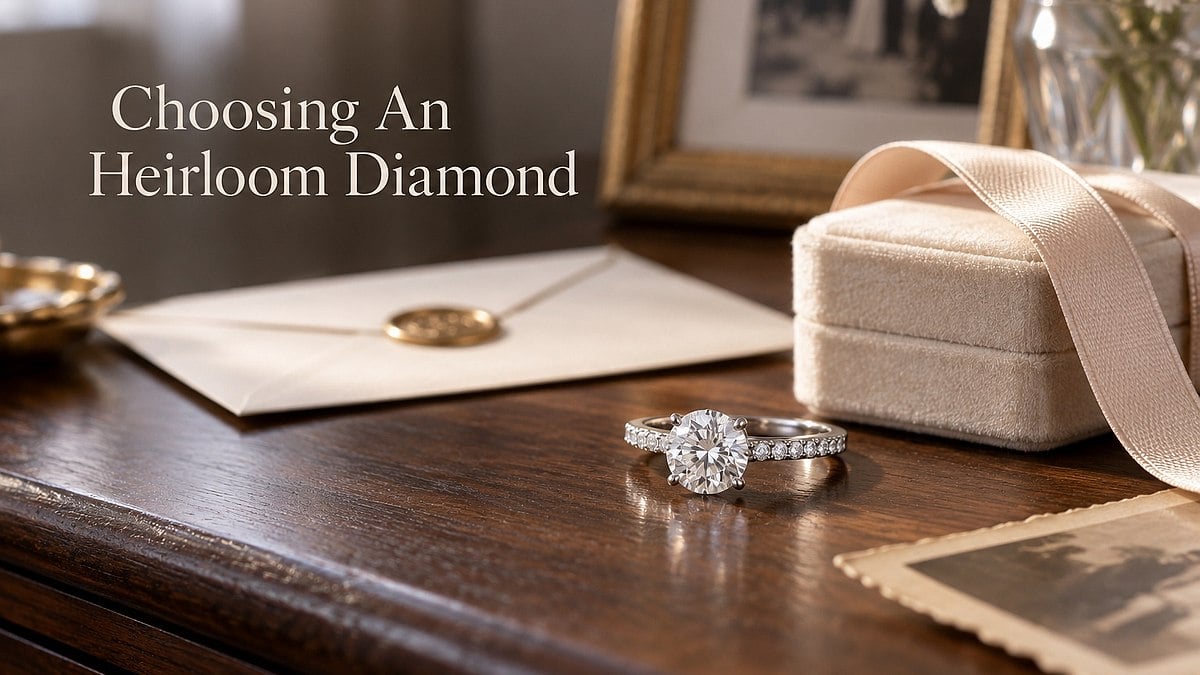

Some diamonds are bought for a moment. Others seem to gather moments around them.
An engagement, an anniversary, a birthday, a quiet piece of self-purchase jewellery that becomes part of someone’s everyday appearance: an heirloom rarely begins with a grand declaration that it must survive for generations. More often, it becomes important because it was worn, remembered and eventually handed on.
That makes choosing an heirloom diamond slightly different from choosing the most impressive stone you can afford today. Beauty matters, of course. So do quality and craftsmanship. But an heirloom also has to live a practical life. It needs a sound setting, sensible documentation, a design that can be maintained, and enough personal appeal that someone actually wants to wear it.
The best heirloom diamond is therefore not necessarily the largest, rarest or highest graded. It is the one where stone, setting, documentation and meaning work together.
Table Of Contents
- What Makes A Diamond Heirloom-Worthy?
- Choose The Diamond For Beauty, Not Paper Perfection
- Think About The Setting As Future Maintenance
- Keep The Paper Trail With The Jewellery
- Choose A Piece Someone Can Actually Wear
- If You Are Choosing From An Existing Family Piece
- What You Can Safely Ignore
- The Real Beginning Of An Heirloom
- Explore The Jewellery
- Frequently Asked Questions
What Makes A Diamond Heirloom-Worthy?
There is no official gemmological grade called “heirloom quality”. The phrase is useful only if we give it a more sensible meaning.
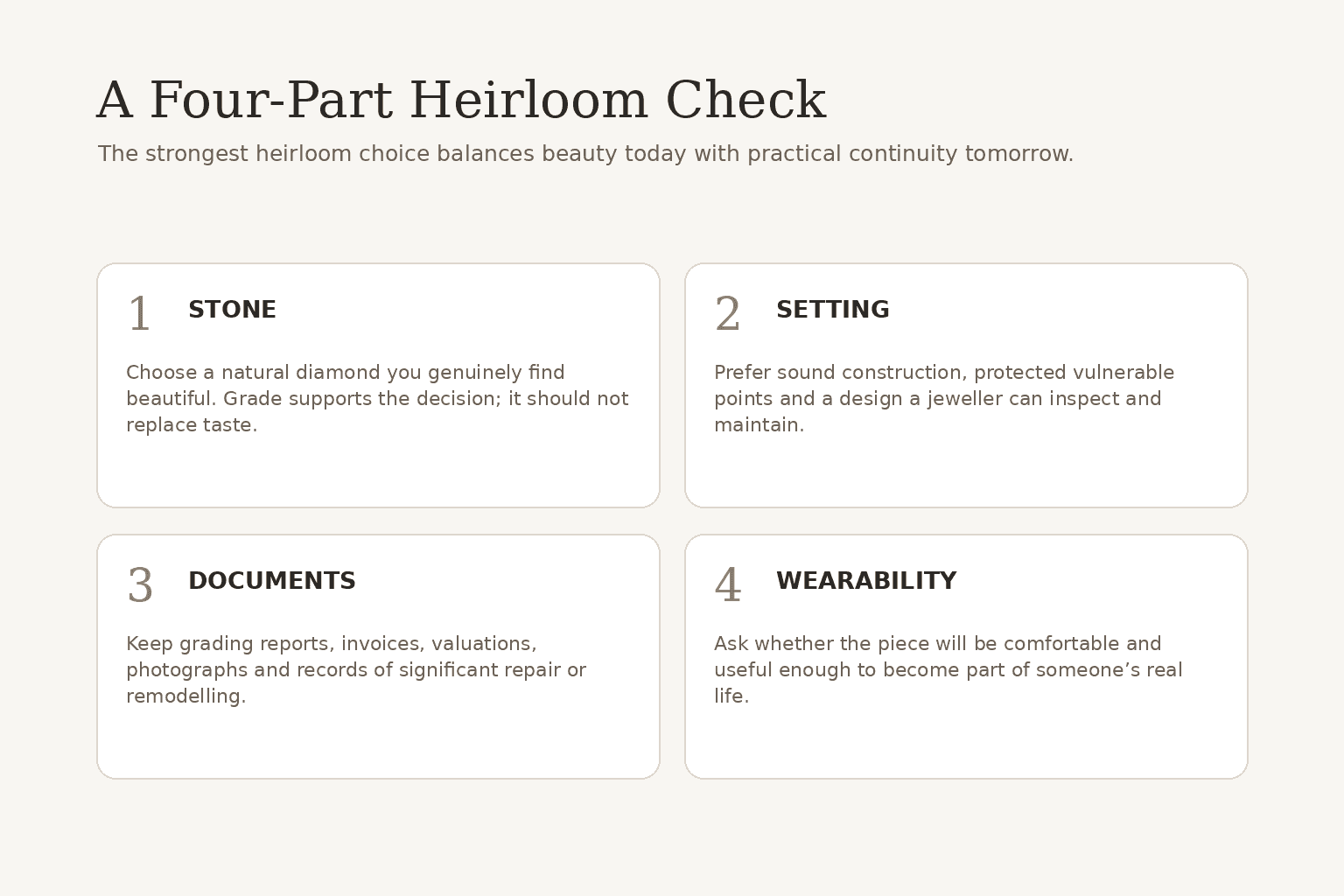
For an heirloom, look for four things:
- A natural diamond you genuinely find beautiful, rather than a grade chosen mainly for status.
- A well-made setting that protects the stone and can be inspected, repaired or resized where the design allows.
- Clear documentation, including any grading report, purchase record, valuation and relevant hallmark information.
- A design with a life beyond one outfit or one season.
That final point matters more than it sounds. Jewellery becomes heirloom jewellery because it participates in somebody’s life. A ring that feels too precious, awkward or stylistically alien to wear may spend decades in a box and still never acquire the emotional weight of a simpler piece worn every week.
Choose The Diamond For Beauty, Not Paper Perfection
The familiar 4Cs remain useful, but an heirloom purchase is a poor place to turn them into a score-chasing exercise.
A high colour or clarity grade can be desirable, yet the visual result is what the next generation will inherit. Cut quality, proportion and the way the diamond works in its setting often matter more to the eye than pushing one already excellent grade another step higher.
For a classic heirloom, round brilliant diamonds remain an obvious choice because their proportions and light performance are familiar and enduring. But “classic” does not mean “round only”. An oval, marquise, pear, emerald or cushion shape can be every bit as lasting when the shape feels personal rather than merely fashionable.
The more useful question is: would this diamond still look intentional if the surrounding fashion changed?
A solitaire gives the stone visual independence. A three-stone ring turns the composition itself into part of the story. An eternity or five-stone ring creates a lower, more continuous line of light. None is automatically more heirloom-worthy than the others.
The right design is the one you can imagine being admired rather than explained. If you are also comparing new rings, our guide to choosing a natural diamond engagement ring covers the broader buying decision.
A Classic Solitaire Leaves Room For The Story
A solitaire is perhaps the clearest example of an heirloom design because very little competes with the diamond itself. All Diamond’s Certified Diamond Solitaire Engagement Ring 1.00ct E/VS Quality in Platinum pairs a round natural diamond with a platinum claw setting. The form is deliberately uncomplicated, which gives future wearers considerable freedom to style it differently from the person who first owned it.

Design Example
Certified Diamond Solitaire Engagement Ring 1.00ct E/VS Quality in Platinum
A round E/VS natural diamond in platinum shows why a simple solitaire can be easy to understand, maintain and restyle over a long life.
Think About The Setting As Future Maintenance
Diamonds are exceptionally hard, but jewellery is not indestructible. A diamond can chip if struck in the wrong direction, and settings wear because they live against skin, clothing, desks, door handles and decades of ordinary movement.
That is why the setting deserves as much attention as the centre stone.
Claws should be substantial enough to secure the stone without overwhelming it. Pointed shapes such as marquise and pear diamonds deserve particular care around vulnerable tips. Rub-over or partial bezel settings can offer more edge protection, while a traditional claw setting gives a more open view of the diamond and can be straightforward for a jeweller to inspect.
The metal also becomes part of the maintenance story. Platinum, 18k gold and 9k gold all have different working properties and wear patterns. What matters is not choosing a fashionable “best” metal, but choosing a well-made mount and understanding that it will need periodic inspection.
An heirloom is not a piece that never needs attention. It is a piece worth maintaining.
Considering A Diamond With A Longer Story?
Classic diamond rings give you a useful starting point for comparing shapes, settings and proportions that can work well beyond one season.
Keep The Paper Trail With The Jewellery
A beautiful stone can outlast almost every document that originally accompanied it, which is precisely why good records should be treated as part of the heirloom.
Keep the grading report where one exists. Keep the original invoice. Keep insurance valuations and update them when appropriate. If the piece will be worn regularly, our practical guide to diamond jewellery insurance is a useful companion. Photograph the piece. Record any resizing, remodelling or major repair.
A UK hallmark can help identify the precious metal and, where present, a date letter can be useful in dating an item. It does not grade the diamond, but it can become part of the object’s history.
For newly purchased diamonds, a laboratory grading report can provide an independent record of the diamond’s measurable characteristics. If a future owner wants a new GIA grading report for a mounted diamond, the stone normally has to be removed from its setting first because GIA issues its standard diamond grading reports for unmounted stones. That is one more reason to preserve the report you already have.
Documentation cannot create sentiment. It can, however, stop valuable information disappearing between generations.
Three Stones Can Carry Their Own Meaning
A three-stone design naturally lends itself to personal interpretation without requiring a fixed symbolism. The 18k White Gold 1.20ct G/SI Diamond Three Stone Ring uses three round natural diamonds in claw settings. Some families may later attach their own meaning to the three stones, but the more important heirloom advantage is visual: it is a balanced, recognisable form that can still feel complete even as styling around it changes.

Design Example
18k White Gold 1.20ct G/SI Diamond Three Stone Ring
Three round natural diamonds create a balanced composition with built-in narrative potential without relying on a trend-led silhouette.
Choose A Piece Someone Can Actually Wear
This is where heirloom shopping can become surprisingly emotional.
It is tempting to think about future value, future generations and future significance before thinking about the first wearer. Yet the most powerful family jewellery is often the piece that still carries traces of a real life: the ring always seen at Sunday lunch, the necklace worn to every wedding, the earrings associated with a particular person’s face.
So ask practical questions.
Will the ring sit comfortably with other jewellery? Is the profile too high for the wearer’s day-to-day life? Can the design be resized if necessary? Are exposed edges likely to catch on clothes? Is the piece so formal that it will only emerge twice a year?
There is no virtue in making an heirloom difficult to live with.
A lower-profile ring or an elegant five-stone design can sometimes become more emotionally important than a larger statement piece simply because it is worn more often.
Continuity Can Be Quieter Than A Solitaire
The 18k White Gold 5 Stone Diamond Eternity Ring 0.80ct in G/SI Quality offers another kind of heirloom language. Five round natural diamonds create a continuous band of light across the finger rather than a single dominant centre. It is the sort of design that can mark an anniversary, sit beside another ring, or eventually be worn on its own by a different generation.

Related Style
18k White Gold 5 Stone Diamond Eternity Ring 0.80ct in G/SI Quality
Five round natural diamonds create a lower, continuous line of light that can work as an anniversary ring, companion ring or standalone heirloom.
If You Are Choosing From An Existing Family Piece
Sometimes the heirloom already exists and the decision is whether to preserve it exactly, restore it or rework it. Our earlier guide to inherited jewellery looks more closely at the family decisions that can sit behind that choice.
Do not rush that decision.
Begin with a professional inspection. Older claws may be worn. Solder joints may have weakened. A diamond may be secure today but not ready for another decade of wear. Estate jewellery can also contain repairs or replacement stones that are invisible to the untrained eye.
Be equally cautious about enthusiastic home cleaning. Older settings can be fragile, and a vigorous brush or unsuitable cleaner may create more risk than sparkle. A jeweller can first check that the stones are secure and then advise on cleaning and restoration.
If the design is emotionally important, preservation may matter more than making it look “new”. Patina, engraving and small signs of wear can be part of the piece’s identity.
If the design will never be worn, thoughtful remodelling may be kinder than permanent storage. GIA’s guidance on repurposing heirloom jewellery makes a useful point: before removing and resetting valuable stones, independent examination can document what the gems are and whether treatments are present, which also helps a jeweller handle them correctly.
The question is not simply “should I keep the old setting?” It is “what part of this object carries the meaning?”
What You Can Safely Ignore
An heirloom purchase attracts grand language, so it helps to know what not to chase.
You can usually ignore the idea that an heirloom must be enormous. You can ignore the pressure to buy the highest possible colour and clarity grades merely because they sound more prestigious. And you can certainly ignore predictions that a normal retail diamond will automatically become a financial investment.
Instead, concentrate on what can actually be preserved:
- a natural diamond whose beauty you understand
- a setting with sound construction
- a design the wearer loves
- complete records
- periodic professional care
- the story of when and why the piece was chosen
That combination is far more likely to survive than a specification sheet chosen without affection.
The Real Beginning Of An Heirloom
An heirloom does not become important because somebody labels it “timeless” on the day it is bought.
It becomes important slowly.
It is worn in photographs. It turns up at celebrations. It develops tiny signs of a particular life. Someone younger remembers it before they ever imagine owning it. Eventually, the diamond is no longer simply a diamond. It is that ring.
Choose quality carefully, certainly. Keep the paperwork. Maintain the setting. But do not forget the part that cannot be certified.
The most successful heirloom is the piece that gives the first wearer so much pleasure that the next wearer already knows its story.
Choose The Piece You Would Want To Remember
Browse natural diamond rings with an eye on beauty, craftsmanship and the kind of wearability that allows jewellery to become part of a life.
Frequently Asked Questions
What diamond shape is best for an heirloom ring?
There is no single best shape. Round diamonds are an enduring classic, while oval, emerald, pear, marquise and cushion shapes can also age beautifully when they suit the wearer and are protected by an appropriate setting.
Does an heirloom diamond need the highest colour and clarity grades?
No. Higher grades can be desirable, but visible beauty, cut, proportion, sound setting and documentation usually matter more than paying for differences that may be difficult to see without expert comparison.
Should an inherited diamond be removed from its setting for grading?
Not automatically. Have the piece inspected first. GIA standard diamond grading reports are issued for unmounted diamonds, so removal is necessary if that specific service is required, but removing a stone should be a considered jeweller-led decision.
How often should heirloom diamond jewellery be checked?
Frequency depends on how often the piece is worn and on the setting. Regular professional inspection is sensible, especially for rings worn daily, because claws and other setting components can wear over time.
Is an heirloom diamond a good financial investment?
Jewellery can retain meaningful and material value, but ordinary retail diamonds should not be bought on the assumption of guaranteed appreciation. Buy for beauty, craftsmanship, documentation and long-term personal meaning rather than a promised investment return.