
A sapphire can win you over before you know anything about it. Perhaps it is the blue against a white shirt, or the way a diamond surround gives that colour a little more presence. Then you read the description, see another apparently similar piece at a very different price, and the questions begin.
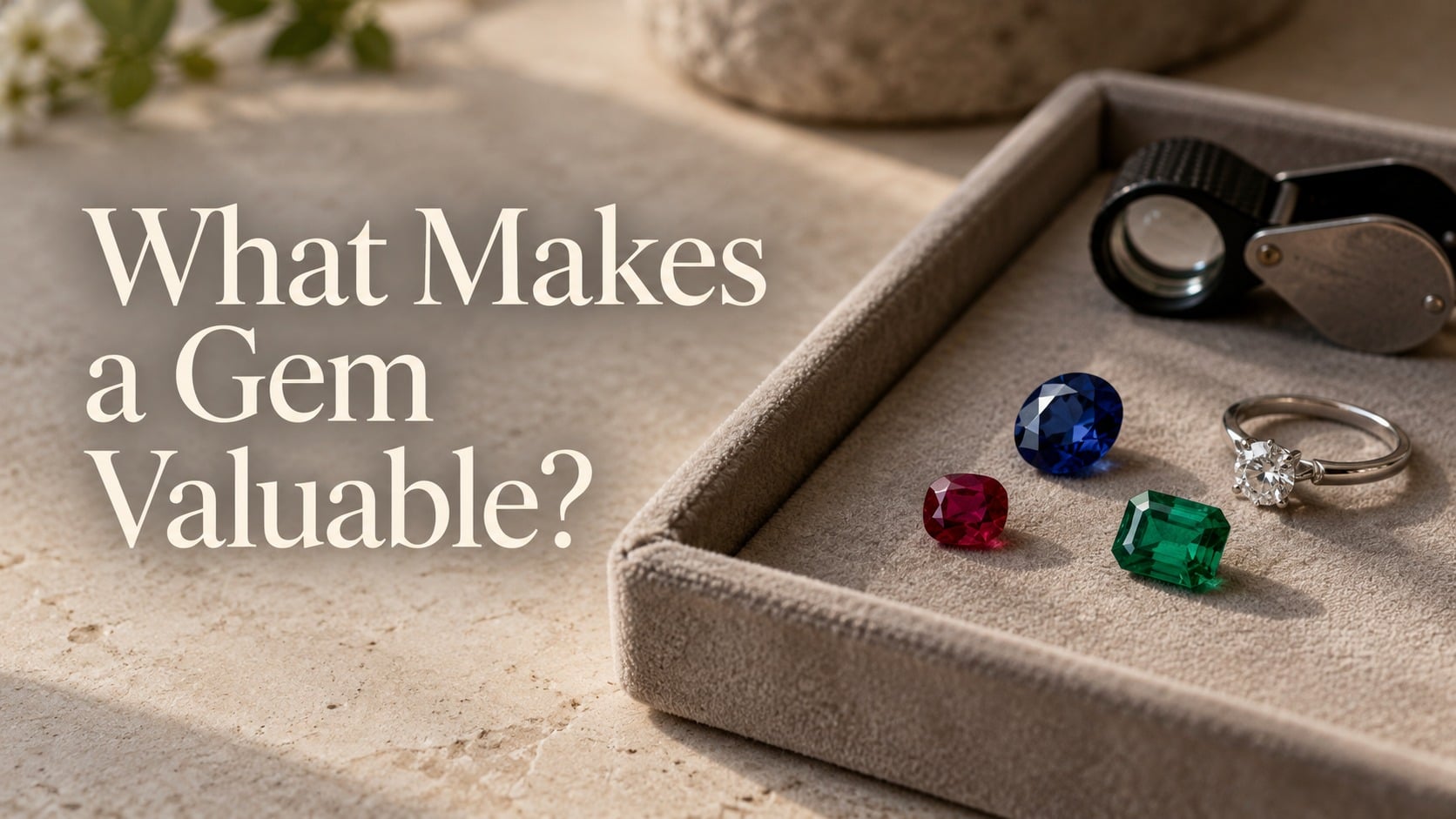
Inside the gemstone market, a name and a carat weight are only the beginning. Colour, clarity, cutting, treatment and, in some cases, documented geographic origin all help explain why stones are valued differently. GIA’s coloured-gemstone value factors set out these interacting factors, rather than a single formula that can price every gem.
For a jewellery buyer, the useful question is not simply “Which stone is worth more?” It is “What am I being asked to pay more for, and does that difference matter to me?” Understanding the answer should make choosing more enjoyable, not turn every lovely ring into an examination.
Table Of Contents
- There Is More Than One Gemstone Market
- Colour Is More Than Darkness
- Natural And Untreated Are Different Claims
- What Origin And Reports Can Tell You
- Look At The Whole Piece, Not Just The Largest Number
- Make Room For Real Life
- Make A Comparison That Means Something
- Explore sapphire rings and emerald pendants with a clearer sense of the questions to ask. Begin with what appeals, then look closely at the individual design and its specification.
- Gemstone Market Questions
There Is More Than One Gemstone Market
A collector searching for an exceptional unheated sapphire may look for different things than someone choosing a beautiful sapphire ring for a birthday. In fine sapphires, evidence that a stone has not been heated can contribute to a rarity premium. That does not mean every buyer needs to make it the centre of their decision. GIA’s guidance on sapphire heat treatment explains why the distinction can affect value.
The auction room is yet another context. Christie’s auction-estimate process considers the individual object, its photographs and provenance, and specialists research appropriate comparisons. A notable auction jewel is not a ready-made price guide for an ordinary retail piece sharing its gemstone name.
Start by deciding what you are buying: a particular rarity, an example of design and craftsmanship, or jewellery that you primarily intend to wear. These motives can overlap. The mistake is assuming that the premium attached to one motive automatically delivers the others.
Our guide to precious and semi-precious stones explores the limitations of those familiar labels. Here, the more useful exercise is to look beyond the label to the particular stone and the evidence accompanying it.
Colour Is More Than Darkness
With coloured gemstones, “richer” should not become a polite way of saying “as dark as possible”. GIA’s sapphire quality guide identifies colour as the most important quality factor and explains the importance of an attractive balance of hue, tone and saturation. A blue sapphire can become so dark that its brightness and colour are less apparent.
Hue describes the colour family and any modifying tint. Tone concerns lightness or darkness; saturation concerns colour intensity. These terms help you describe what you are seeing, but they do not tell you which blue belongs in your jewellery box. A softly violet-blue stone and a deeper blue can appeal for quite different reasons.
Look beyond the outline, too. Cutting affects how light and colour move through a stone. A pale, see-through area, often called a window, or extensive dark areas can interrupt its appearance. GIA’s coloured-gemstone value factors discuss these effects. A shape name such as oval or cushion does not, by itself, establish the quality of the cutting.
My practical preference is to compare pieces under similar conditions and ask for more than a single flattering photograph. Look at the overall impression at a normal viewing distance before studying an enlarged detail. You are choosing something to enjoy on the hand, at the neckline or beside the face, not only under magnification.
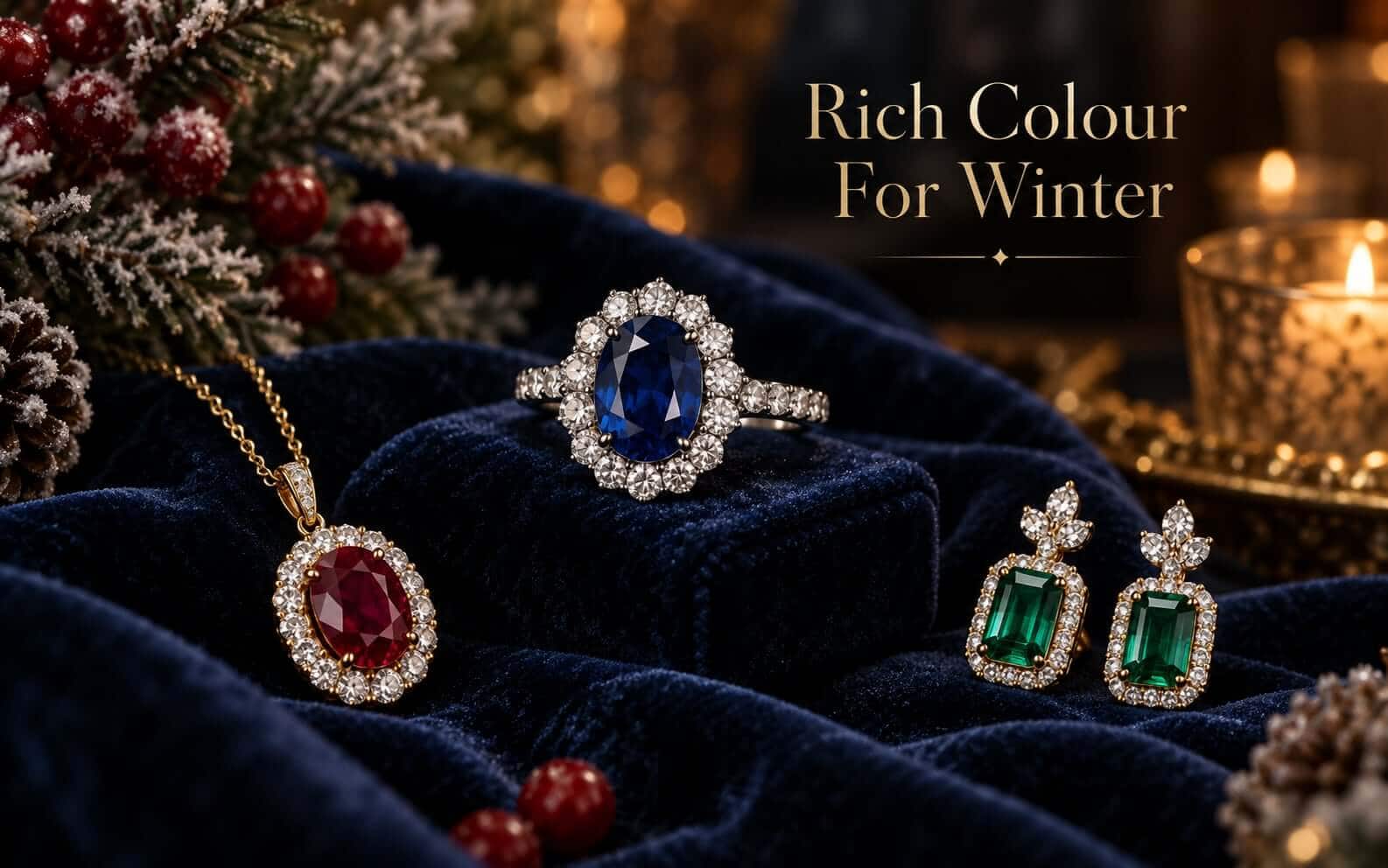
A diamond surround also changes how a coloured centre stone is presented. This sapphire cluster shows the contrast between a blue centre and its bright frame.

Design Example
Oval 1.00ct Blue Sapphire 0.30ct Diamond Cluster Ring 18k White Gold
An oval blue sapphire provides the colour, while the surrounding diamonds and white gold give it a bright frame. The listing separates the 1.00ct sapphire from the 0.30ct total diamond weight, making the composition easier to understand. This is a design example, not a claim about an untreated or origin-certified sapphire.
Find Your Kind Of Blue
Begin with the colour and silhouette that draw your eye. Then compare the details that explain the piece.
Natural And Untreated Are Different Claims
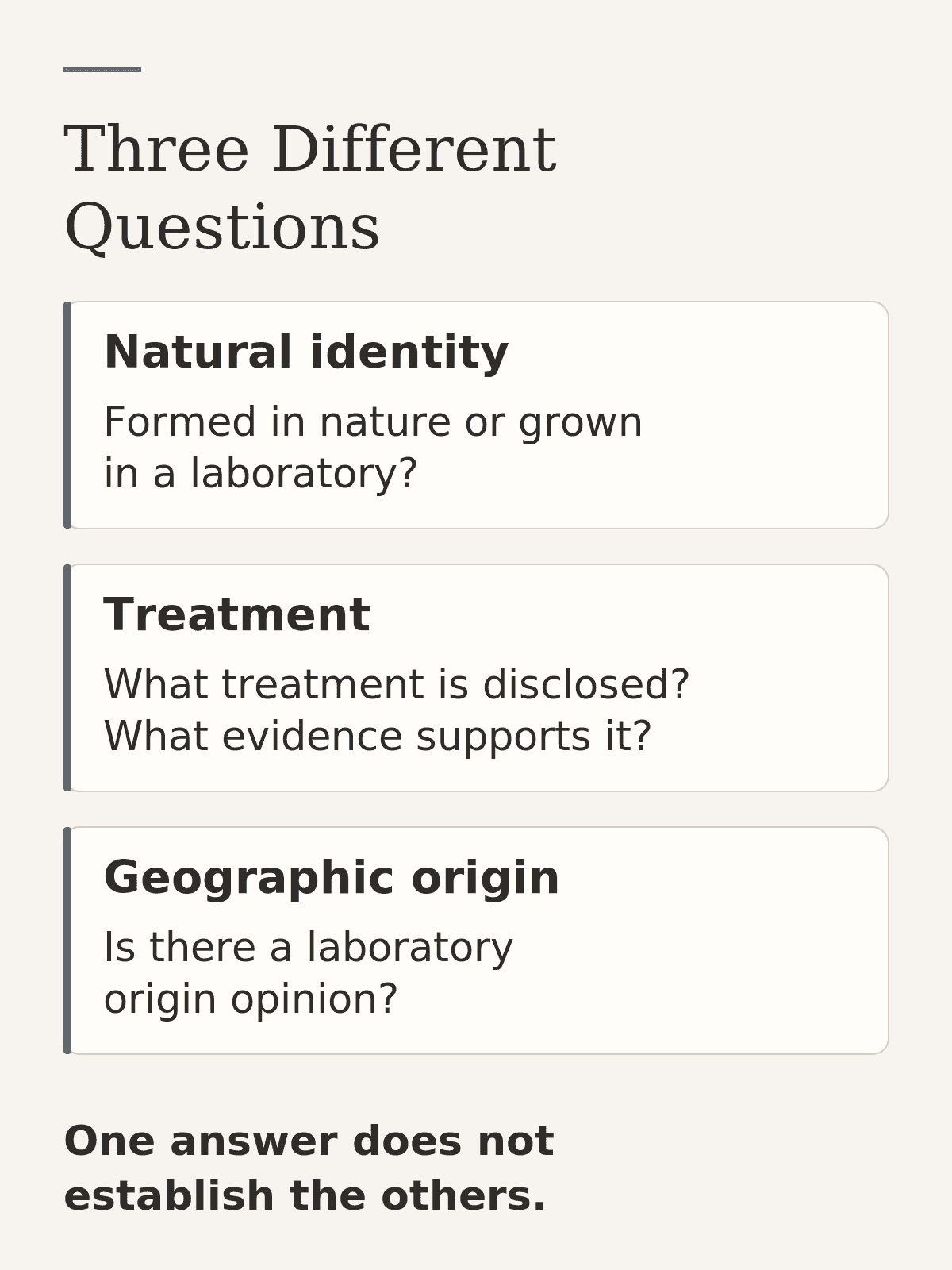
“Natural” describes a gemstone formed in nature rather than grown in a laboratory. It does not establish that the stone is untreated. Identification and treatment are separate matters in GIA’s coloured-stone report guidance. That distinction deserves a clear answer before it becomes part of a price comparison.
Traditional heat treatment is widely accepted for sapphires. An otherwise comparable fine stone with a reliable report finding no evidence of heat may command more because that combination of qualities is rarer. But “heated” is not a complete treatment description for every possible stone: GIA’s sapphire buying guide also distinguishes processes such as lattice diffusion. Ask what was done, rather than treating all treatments as interchangeable.
Emeralds present a different question. Oils or resins can be used to reduce the visibility of surface-reaching fissures. The degree of clarity enhancement is relevant when comparing emeralds; GIA’s emerald buying guide explains how laboratory reporting can describe its extent. Natural formation and clarity enhancement are not mutually exclusive.
None of this calls for alarm. It calls for disclosure. Ask for the treatment information in writing, ask what evidence supports it, and check whether it changes the care required. A disclosed treatment is a fact you can evaluate. An unanswered question is not a sound basis for paying an untreated premium.
What Origin And Reports Can Tell You
A celebrated place name can be part of a gemstone’s appeal. Nevertheless, GIA’s sapphire buying guide makes a useful point: mines produce a range of qualities. Geographic origin does not redeem an unattractive colour, and a less famous source does not disqualify a beautiful stone.
There is also an important difference between a seller’s description and a laboratory origin opinion. GIA’s explanation of geographic origin describes how specialists compare a stone’s characteristics with reference material. Some sources overlap in their gemmological characteristics, so a conclusion is not always possible. Read the actual wording instead of turning an opinion into an absolute promise.
An identification report, an origin opinion and an appraisal do different jobs. A suitable laboratory report can address identity and detectable treatments; an origin report adds a geographic opinion where the service applies. GIA does not put a monetary value on the gemstone in that report. GIA’s distinction between reports and appraisals explains why an appraisal is a separate exercise.
Ask which particular stone any document covers and whether the document actually supports the claim that matters to you. Do not assume that a report for a centre stone also covers every small diamond surrounding it. For a substantial origin or treatment premium, request the report before deciding, not as an afterthought once the jewellery has been chosen.
Look At The Whole Piece, Not Just The Largest Number
A finished jewel deserves to be assessed as a finished jewel. My comparison would include the main gemstone, the accompanying diamonds, the chosen metal, the setting and the way the design sits when worn. Dividing the price by a single headline carat weight can conceal more than it reveals.
Start by separating the weights. Is the figure for the centre stone, all coloured stones, all diamonds, or every stone combined? For earrings, is it the total for the pair? The answers should be explicit before two product descriptions are treated as equivalent.
Size also belongs alongside quality, not ahead of it. GIA’s ruby quality guide explains why large, fine-quality rubies can command substantially higher prices per carat than smaller examples. That is a relationship between size, quality and rarity, not a rule that a larger ruby is always the more pleasing choice.
Then return to the design. Does the surround allow the centre room to be seen? Are you drawn to a close, compact outline or a more expansive cluster? Would you prefer the same colour in earrings rather than a ring? Our exploration of diamond and gemstone pairings takes that design question further.
The distinction becomes particularly useful with earrings, where an impressive-looking total may describe several stones across two pieces.

See The Detail
1.60ct Ruby & Diamond Oval Cluster Earrings 18k Yellow Gold
The title’s 1.60ct is the combined gemstone weight across the pair: 1.20ct of rubies and 0.40ct of diamonds. It is not 1.60ct of diamonds, nor the weight of each earring. Oval ruby centres, diamond surrounds and 18k yellow gold create the finished design.
Make Room For Real Life
Before paying extra for a quality distinction, picture an ordinary day with the piece. Not the presentation box. Think of the clothes you wear, whether rings get in your way, and whether you enjoy changing your jewellery or tend to reach for the same few pieces.

Care can alter the choice of design. Emeralds have different durability considerations from sapphires and rubies, and some clarity-enhancing substances need particular care. GIA’s emerald care advice advises against ultrasonic and steam cleaning and recommends gentle cleaning with warm, soapy water. Obtain care advice for the specific jewel, including any known treatment, rather than applying a diamond-cleaning routine to every gemstone.
That does not make an emerald a poor choice. It may make a pendant a better personal choice than a ring worn through every task. Equally, a ring you happily remove for unsuitable activities may fit your habits perfectly. Wearability is not the opposite of refinement; it is one of the reasons a piece becomes well loved.
For someone drawn to green but reluctant to wear a coloured-stone ring, a pendant offers a different place for that colour in the wardrobe.

Related Style
Emerald 0.70ct with Diamond Pendant Necklace in 9k White Gold
This 9k white-gold pendant places a rectangular emerald within a diamond surround. The listing identifies a 0.70ct emerald and 0.20ct total diamond weight. Consider it as a way to enjoy green near the face, rather than as evidence of a particular emerald origin or treatment status.
Make A Comparison That Means Something
Imagine two sapphire rings with much the same outline. You prefer the colour of one, but the other costs more and has a laboratory report supporting a sought-after origin and no evidence of heat. Do not dismiss that evidence. Equally, do not pretend it changes which blue you enjoy looking at.
I would separate the decision into three questions. First, which piece appeals most when the descriptions are put aside? Second, what verified difference explains the premium? Third, is that difference part of what you intended to buy?
A collector may reasonably prioritise documented rarity. Someone choosing a signature piece may give more weight to colour, design and comfort. Neither needs to borrow the other’s priorities to make a considered choice. Our guide to sapphires for the modern collector offers further context for a collection-led approach.
The gemstone market becomes easier to navigate when you stop expecting one number to settle every question. Let the evidence explain the jewel. Let your eye, your taste and your life decide whether it is the one you will enjoy wearing.
Find Colour You Will Enjoy Wearing
Explore sapphire rings and emerald pendants with a clearer sense of the questions to ask. Begin with what appeals, then look closely at the individual design and its specification.
Gemstone Market Questions
Why Can Two Gemstones Of The Same Weight Cost Different Amounts?
Weight is only one factor. Colour, clarity, cutting, treatment and documented origin can differ, while finished jewellery also has its own design and metal specification. Compare the particular stones and pieces, not just their carat totals.
Does Natural Mean Untreated?
No. A gemstone can have formed naturally and later been treated. Ask separately about natural identity and treatment, with supporting documentation where those claims affect your decision.
Is An Unheated Sapphire Always A Better Choice?
Not necessarily for the wearer. Lack of heat treatment can contribute a rarity premium in fine sapphires, but it does not replace an assessment of colour, cutting, condition or personal appeal. Verify the claim before paying a premium for it.
Does A Gemstone Report Tell Me What A Stone Is Worth?
A gemmological report is not the same as an appraisal. Check its scope: it may identify the material, record detectable treatments and, for an appropriate report, offer an origin opinion. It should not be treated as a promised resale price.
Do The Featured Products Have Confirmed Untreated Or Geographic-Origin Status?
This feature does not establish either claim for the selected products. They illustrate design and the way weights are described. Ask All Diamond about the specific gemstone and any supporting report before relying on a treatment or origin claim.