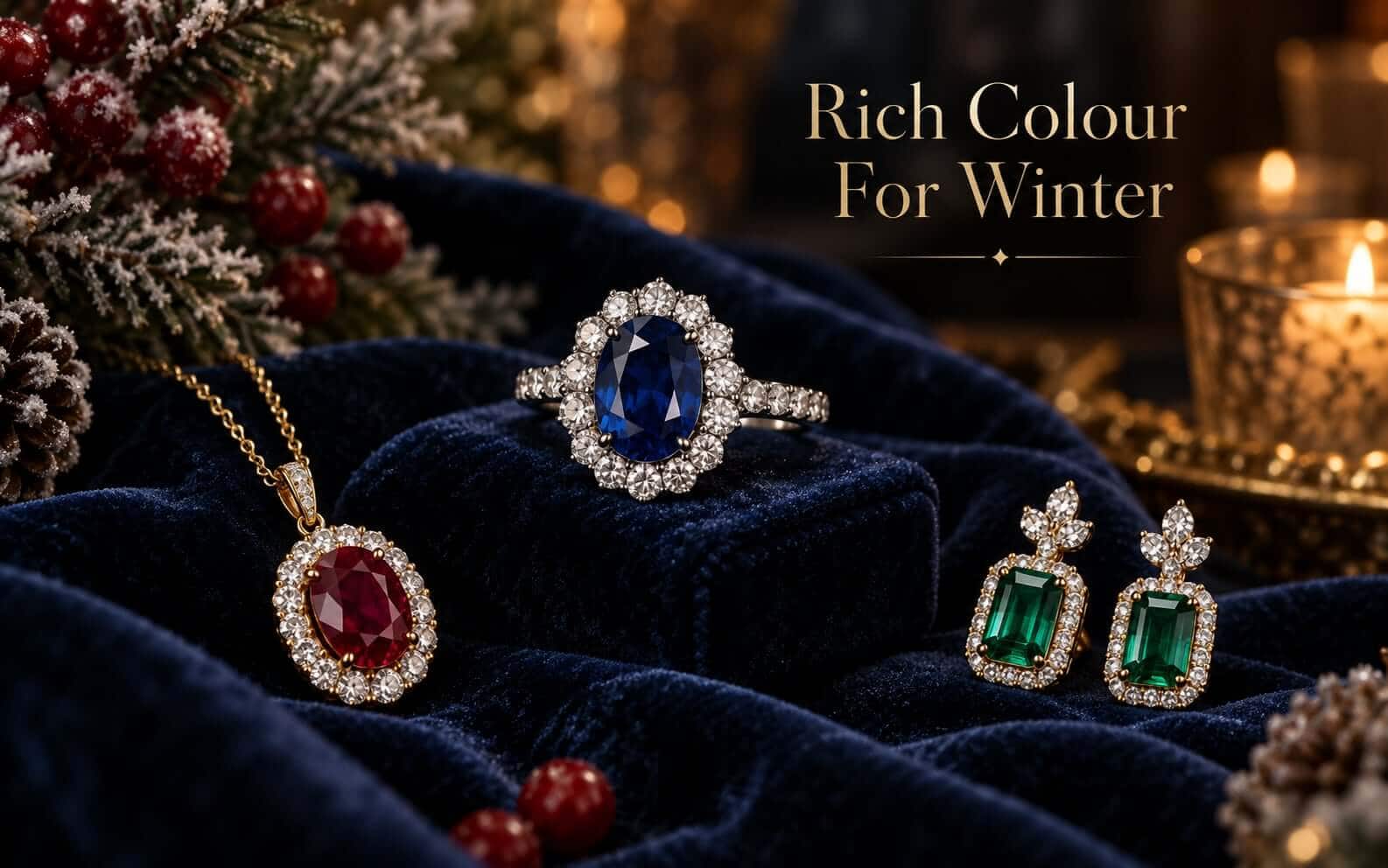

The coat comes off, the scarf is folded away, and a familiar dark outfit needs very little else. A ruby pendant in the opening of a blouse. Emerald earrings above a plain neckline. A sapphire ring that gives the hand a concentrated point of colour.
Winter gemstone jewellery can be opulent without becoming an exercise in adding more. The richer effect often comes from the relationship between one jewel and what surrounds it: the depth of a fabric, the shape of a neckline, the amount of metal visible around a stone.
Start there, rather than with a list of pieces a winter wardrobe is supposed to contain. Choose a colour you enjoy, give it a convincing place in the outfit, and then decide whether anything else is needed. This is a styling approach, not a claim about which gemstones everyone will be wearing this season.
Table Of Contents
- Choose Rich Colour, Not Simply A Darker Stone
- Give The Gemstone A Clear Background
- Ruby: A Deliberate Accent Against Quiet Clothes
- Emerald: A Lively Counterpoint To Winter Neutrals
- Sapphire: Depth With A Brighter Edge
- Let The Fabric Decide How Much Detail You Need
- Match The Gemstone To The Way You Wear It
- Keep The Colour, Lose The Obligation To Add More
- Let One Colour Complete The Outfit
- Frequently Asked Questions
Choose Rich Colour, Not Simply A Darker Stone
There is an important difference between a colour that feels rich and one that is merely dark. A stone can be deeply toned but reveal little of the colour that attracted you in the first place. Equally, a brighter stone can look wonderfully substantial when it is framed by a quieter outfit.
Blue sapphire makes a useful example. GIA's sapphire quality guide distinguishes saturation from tone and notes that a sapphire can be too dark. A darker stone is not automatically a better one. For winter dressing, my preference is to look for colour that remains enjoyable in the settings where the jewellery will actually be worn.
Ask to see a prospective piece in more than one lighting condition. Where a seller can supply it, ordinary-light video of the actual jewel is more informative than relying on a single strongly lit image. This is a practical viewing suggestion, not a way to grade a gemstone through a screen.
Then bring the decision back to your wardrobe. Would you rather have a clear red punctuation mark against charcoal, a blue-on-blue combination or green beside warm brown? You do not need to choose the rarest colour to create the most satisfying outfit.
Give The Gemstone A Clear Background
Before buying anything, choose two or three garments you already enjoy wearing in colder weather. Include the outfit as it will look indoors, not only the coat that covers it outside. A jewel needs a useful place after the winter layers have been removed.
With a plain open neckline, a pendant can become the central detail. A high neckline often makes earrings the easier choice, while a ring remains visible when a necklace would be hidden or visually lost. The garment suggests a position; the jewel supplies the colour.
Texture changes the styling decision too. Fine diamonds and delicate outlines may become harder to read against a busy, chunky knit. You could move the jewellery to the ears, choose a clearer outline or wear the pendant against a plain area rather than the most textured part of the outfit. These are alternatives, not a reason to rule out knitwear.
A useful starting formula is one coloured focal point and one quieter companion, if a companion is needed at all. That might mean a ruby pendant with simple earrings, or emerald earrings with a plain band. You can always add more after seeing the first arrangement.
Choose Where The Colour Will Sit
Start with the place your winter clothes leave visible: the neckline, the ears or the hand. The category can follow the outfit.
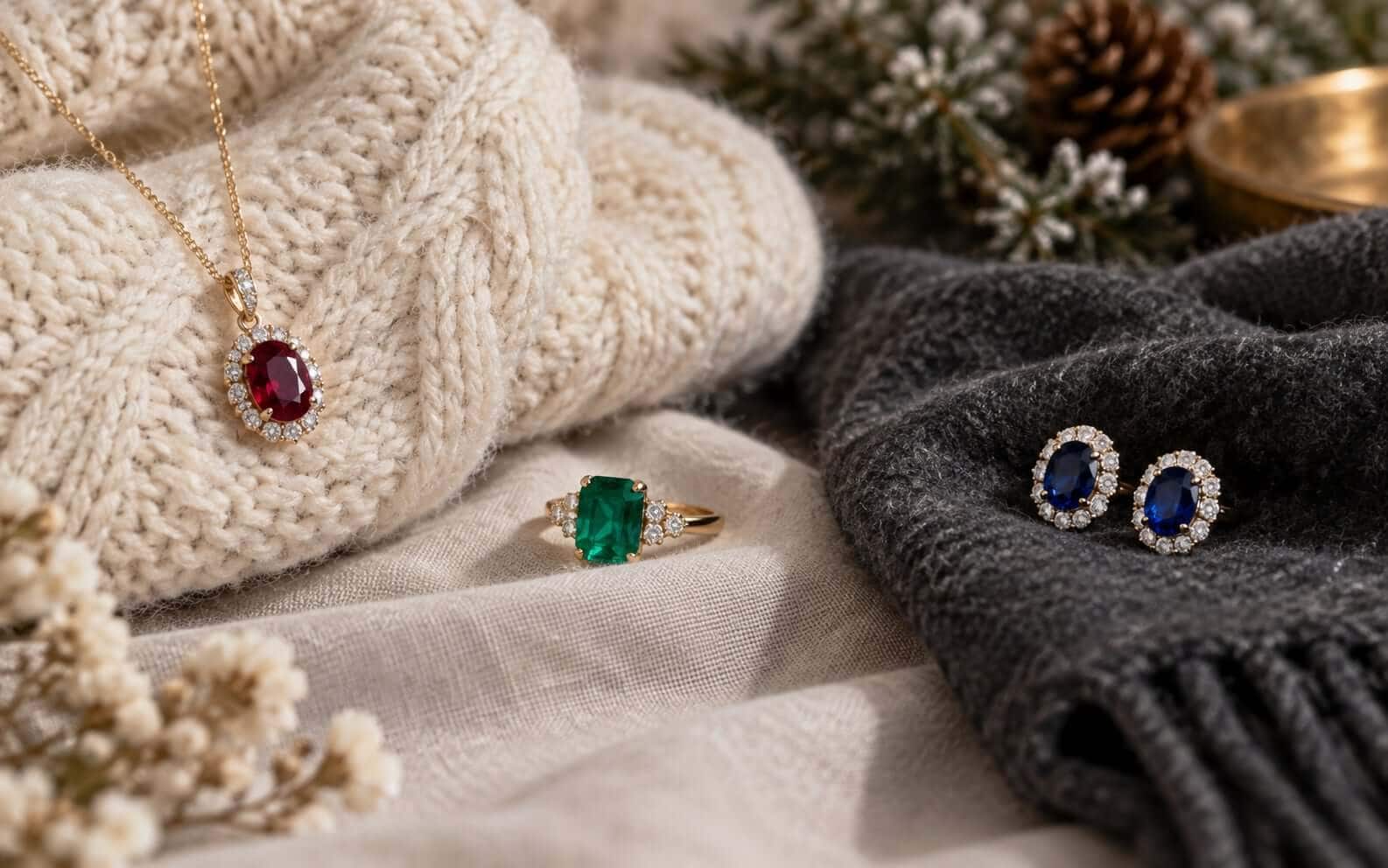
Ruby: A Deliberate Accent Against Quiet Clothes
For a straightforward winter combination, try ruby with charcoal, cream or a plain black neckline. The red becomes the deliberate accent rather than part of a much larger pattern. This is particularly appealing when the rest of the outfit has familiar, uncomplicated lines.
A pendant gives you control over where that accent sits. Check its dimensions and chain options against your usual necklines. A necklace that hangs neatly inside an open blouse may sit awkwardly against the edge of a crew neck. You do not need an exact universal length; you need the length that gives the pendant a clear position on you.
The ruby pendant below keeps the coloured centre distinct, with a diamond detail above it rather than a broad surrounding halo. Its restrained outline is useful when you want the red to carry the effect. The current title states a 1.00ct ruby; the separate specification lists 0.11ct of diamond.

A Single Red Accent
Ruby 1.00ct Oval with Diamond Pendant Necklace in 9k White Gold
An oval 1.00ct ruby is paired with 0.11ct of diamonds in 9k white gold. The compact arrangement offers a clear point of colour rather than a broad, decorative surround.
You need not echo the ruby elsewhere. Repeating it in earrings, a ring and a bracelet can be a confident choice, but it changes the character of the arrangement. For the lighter approach here, allow the pendant to be the only red jewel and let the clothes supply the remaining interest.
A tonal outfit is another possibility. Try the red against a deeper wine-coloured garment, then judge whether the stone is still distinct enough for your taste. There is no need to force a match. Sometimes the slight difference between two reds is the attraction; sometimes a quieter background gives the better result.
Emerald: A Lively Counterpoint To Winter Neutrals
Green offers a different kind of richness. I would try emerald earrings with chocolate brown, a soft cream collar or uncomplicated black tailoring. The colour can become the fresh element in an otherwise subdued combination without turning the whole outfit bright.
Earrings are especially useful when a scarf or high neckline makes a necklace inconvenient. Consider their position after the scarf comes off, as well as any contact while it is being wrapped or removed. A neat stud or compact cluster can be easier to organise around winter layers than a long, projecting design, although the actual setting still deserves checking.
The emerald-and-diamond earrings below give the green an outlined frame in yellow gold. Their headline 1.00ct is the combined gemstone total for the pair: the description separates 0.85ct of emeralds from 0.15ct of diamonds. The stones are not being presented as one carat of emerald in each ear.

Green With A Warm Frame
1.00ct Emerald & Diamond Oval Cluster Earrings 18k Yellow Gold
Oval emeralds and diamond surrounds are set in 18k yellow gold. The 1.00ct combined gemstone weight comprises 0.85ct of emeralds and 0.15ct of diamonds across the pair.
For this arrangement, keep a nearby necklace quiet or leave it out. The point is to give the emeralds a clear role near the face, rather than make them compete with another detailed piece directly below.
The same principle can work in daylight. There is no requirement to reserve rich colour for a formal evening. Try the earrings with a favourite plain jumper or a shirt and jacket. If the combination feels more like you than an elaborate occasion outfit, that is a good reason to wear it.
Sapphire: Depth With A Brighter Edge
Sapphire suits a winter palette without having to disappear into navy. One approach is to keep the blue tonal with the clothes and introduce separation through the setting. A surrounding arrangement of white diamonds can give the coloured centre a clearly defined edge.
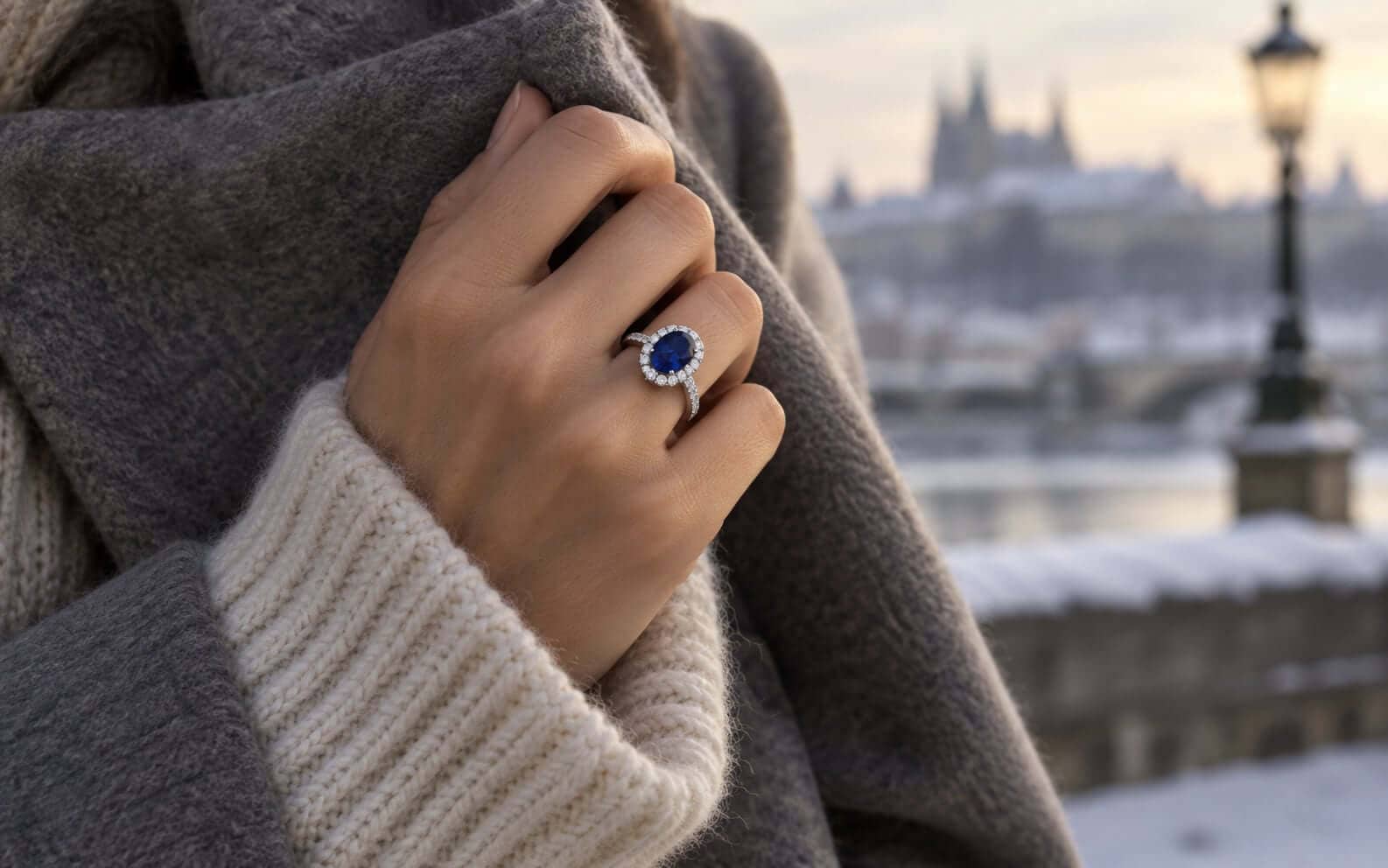
Another is to let the sapphire stand apart from its background. A blue ring beside a cream cuff, for example, gives the colour room to be seen. A dark, unpatterned sleeve can also make the contrast between the stone, diamonds and metal more apparent. These are styling choices to try, not fixed rules about which colours belong together.
The white-gold halo ring below illustrates a coloured centre with a brighter surround. Its 0.80ct headline combines a 0.60ct blue sapphire with 0.20ct of diamonds, including those on the shoulders. It is not a 0.80ct sapphire, and the distinction matters when comparing it with another design.

Blue With A Brighter Edge
Blue Sapphire & Diamond 0.80ct Halo Ring in 18k White Gold
A 0.60ct blue sapphire is framed by diamonds in an 18k white-gold halo design. The 0.20ct diamond total includes the shoulders, making 0.80ct of combined gemstones, not a 0.80ct sapphire.
A ring can be a particularly satisfying choice when you want to enjoy the colour yourself throughout the day. Try it with the other rings you normally wear, rather than in isolation. A favourite everyday band may be all the company it needs.
For more on the design relationship within a piece, our guide to diamond and gemstone pairings explores how coloured centres and diamonds work together. Here, the extra step is to consider the garment as part of the composition too.
Let The Fabric Decide How Much Detail You Need
A jewel can look more opulent when the background is quiet enough for its details to be noticed. That is why a single coloured pendant may feel complete against a plain blouse, while the same pendant gets lost among ruffles, buttons and a strongly patterned scarf.
Instead of automatically choosing something bigger, first change its position or the clothing around it. Move the focus from necklace to earrings. Turn back a cuff to give a ring more space. Choose a cleaner neckline. Often, the useful adjustment is not another purchase but a clearer relationship between things you already own.
Metal colour is part of that relationship. Yellow gold can be a warm note beside brown or cream. White gold can provide a cooler, more defined outline. You do not have to decide that one metal suits an entire season, or that every visible piece must use exactly the same metal.
Do keep an eye on how many strong ideas are operating close together. A heavily decorated neckline, large coloured earrings and a detailed pendant can all be attractive individually, yet leave you unsure where to look when worn together. Try removing one and compare the effect in an ordinary mirror, at a normal distance.
Those who enjoy a fuller look need not be talked out of it. A deliberate arrangement of several gemstones can be beautiful. The difference is that you have chosen the relationships, rather than kept adding pieces because the outfit did not initially feel finished.
Our fine jewellery colour guide offers a broader palette. For this winter approach, let the question stay smaller: which colour, in which position, makes this particular outfit feel complete?
Match The Gemstone To The Way You Wear It
A seasonal colour preference should not obscure practical differences between stones. Jewellery is more enjoyable when its care fits the way you intend to use it, particularly if the piece will become part of an ordinary routine rather than an occasional treat.
GIA describes ruby and sapphire as hard, tough gemstones suitable for everyday-wear designs, while also noting that some treatments require extra care. That is not a promise that every ruby or sapphire ring can be treated alike. Ask about the particular stone and its setting.
Emerald requires more care than ruby or sapphire, and GIA advises against ultrasonic or steam cleaning because of the risks associated with fractures and fillers. It remains a beautiful jewellery choice, but its care should be understood rather than reduced to "all gemstones are durable".
Tanzanite is another attractive colour option for winter. It also needs a different approach: GIA notes its lower toughness and advises precautions against hard blows, as well as avoiding ultrasonic and steam cleaning. Choosing a pendant or earrings may better suit someone who is hard on rings, but no mounting makes a stone immune to damage.
With any of these pieces, use the jeweller's care instructions and check settings and fastenings. Take rings off for tasks likely to expose them to knocks or chemicals, and make a habit of putting them somewhere secure rather than loose in a pocket. Letting one gemstone become a regular companion is a pleasure worth looking after.
Keep The Colour, Lose The Obligation To Add More
The strongest winter jewellery choice may be the piece that allows you to stop. A red pendant gives a dark blouse its point of interest. Green earrings make a simple jumper feel considered. A blue ring adds enough detail to a quiet sleeve.
There is no need to buy all three approaches, let alone wear them at once. Choose the one that belongs most naturally with your clothes and your habits. A winter edit can be a new way of wearing a piece you already own, not necessarily the start of a new collection.
Opulence, here, is the enjoyment of colour, texture and a well-chosen detail. Give those things a little room, and a single gemstone can do a great deal.
Let One Colour Complete The Outfit
Choose the gemstone and position that work with your own clothes. A single well-placed piece can offer all the richness you were looking for.
Frequently Asked Questions
Which Gemstones Work Well With Winter Clothes?
Ruby, emerald and sapphire offer three useful colour approaches, but there is no compulsory winter gemstone. Judge the actual stone against the clothes and lighting you expect to wear it with. A paler or brighter colour can be just as satisfying as a deep one.
Does A Darker Gemstone Always Look Richer?
No. Tone and saturation are different qualities. A stone that is too dark for the conditions may show less of the colour you hoped to enjoy. Ask to see the actual gem in more than one ordinary lighting condition.
Can I Wear Gemstone Jewellery With Knitwear?
Yes. Give the design a clear background and consider its position. Earrings may work better with a roll neck, while a pendant can suit a simpler neckline. Be mindful of projecting details around loose or textured fibres.
Do Coloured Gemstones Need Matching Outfits?
No. Try a complementary, contrasting or quiet neutral background rather than requiring an exact colour match. One clear focal point can make the relationship easier to judge, especially when the garment already has texture or detail.
Can I Clean All Gemstones In The Same Way?
No. Species, treatments and settings matter. GIA advises against ultrasonic and steam cleaning for emerald and tanzanite, and some ruby and sapphire treatments also need extra care. Ask for the instructions applying to your particular piece instead of using a universal cleaning method.